
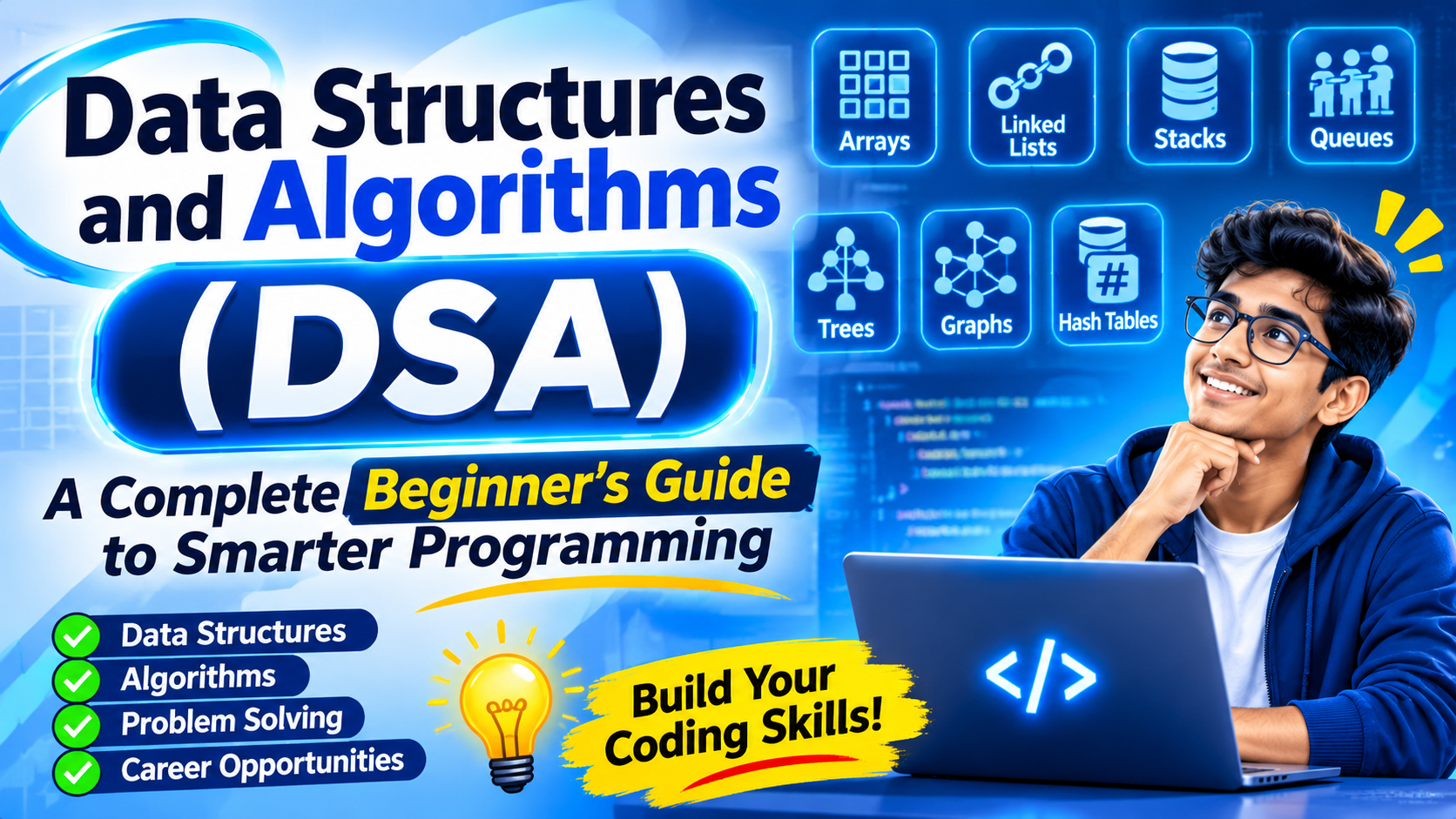
Data Structures and Algorithms (DSA): A Complete Beginner's Guide to Smarter Programming
Have you ever wondered how applications process thousands of data records within seconds or how search engines find the exact information you are looking for?
Behind these everyday technologies, Data Structures and Algorithms (DSA) play an important role.
DSA is one of the fundamental concepts in programming and software development. It helps developers organise information, solve problems logically, and build applications that work efficiently.
Whether you are a beginner learning to code or someone planning to become a software developer, understanding DSA can give you a strong foundation.
What Are Data Structures and Algorithms?
In simple terms, Data Structures are ways of organising and storing information so that it can be easily accessed and managed. Algorithms, on the other hand, are the steps followed to solve a particular problem.
Think of a library. Books are arranged in different sections so that people can find what they need without wasting time.
Data Structures work in a similar way by keeping information organised, while Algorithms help determine the best way to find or process that information.
Some commonly used data structures include:
1. Arrays: Help store multiple values in a single organised collection.
2. Linked Lists: Connect different data elements through links.
3. Stacks: Work on the Last In, First Out (LIFO) principle.
4. Queues: Follow the First In, First Out (FIFO) principle.
5. Trees:Organise information in a hierarchical structure.
6. Graphs: Represent connections and relationships between different elements.
7. Hash Tables: Help store and retrieve information using key-value pairs.
Important DSA Concepts Every Programmer Should Know
Learning DSA is not just about understanding different data structures. It is also about knowing how to solve problems effectively.
Some important concepts include:
- Searching:Helps find specific information within a collection of data.
- Sorting: Arranges data in a particular order.
- Recursion: Allows a function to solve a problem by breaking it into smaller problems.
- Time Complexity: Helps understand how much time a program may require.
- Space Complexity:Helps understand how much memory a program may require.
Popular algorithms include Linear Search, Binary Search, Bubble Sort, Merge Sort, and Quick Sort.
Why Do Developers Need to Learn DSA?
Writing a program that works is important, but writing a program that works efficiently is equally important.
Imagine an application that takes several minutes to find a simple piece of information. Users may not have the patience to wait.
This is where DSA makes a difference. It helps developers choose better ways to organise and process information.
Learning DSA can help developers:
- Improve logical thinking and problem-solving abilities.
- Write faster and more efficient programs.
- Handle large amounts of data.
- Improve application performance.
- Prepare for technical interviews and coding assessments.
From web applications to search engines and database systems, DSA is an important part of modern software development.
How to Start Learning Data Structures and Algorithms?
For beginners, DSA may seem difficult at first. However, learning it step by step and practising regularly can make the process much easier.
Here are a few ways to get started:
1. Understand Programming Basics
Start with variables, loops, functions, and conditional statements.
2. Learn Basic Data Structures
Begin with arrays, strings, linked lists, stacks, and queues.
3. Explore Algorithms
Understand searching, sorting, and recursion with simple examples.
4. Practise Coding
Solve small programming problems regularly to improve your skills.
5. Learn Big O Notation
Understand how to measure the time and memory efficiency of your code.
6. Work on Real Problems
Apply what you learn to practical coding challenges.
7. Prepare for Interviews
Practise common DSA questions asked in software development interviews.
Consistency is more important than trying to learn everything at once.
Why Consider Learning DSA with NextGenPro?
Building a successful career in technology starts with developing the right technical foundation.
At NextGenPro Innovations and Edupark Pvt. Ltd., we focus on helping learners develop the knowledge and skills needed to explore opportunities in the technology industry.
Understanding DSA can help aspiring developers strengthen their programming fundamentals, improve their logical thinking, and become more confident when solving coding problems.
For graduates who are interested in software development, learning these concepts can be a valuable step towards building a career in the IT industry.
Career Opportunities After Learning DSA
DSA is a valuable skill for anyone interested in software development. A good understanding of these concepts can help learners prepare for different technical roles and improve their performance in coding interviews.
Some career paths include:
- Software Developer
- Python Developer
- Java Developer
- Backend Developer
- Full Stack Developer
- Application Developer
DSA knowledge can also help candidates perform better in technical assessments conducted by IT companies.
Which Programming Language Is Best for Learning DSA?
One of the common questions beginners ask is which programming language they should choose for learning DSA.
The good news is that DSA can be learned using several programming languages, including Python, Java, C++, and JavaScript.
Python is often a comfortable starting point for beginners because its syntax is simple and easy to understand.
Java and C++ are also widely used for practising DSA and solving programming challenges.
The best choice depends on your learning goals and programming background.
Conclusion
Data Structures and Algorithms are much more than programming concepts. They help developers think logically, approach problems creatively, and build software that performs better.
If you are planning to enter the IT industry or improve your programming skills, learning DSA is a great place to start.
Begin with the basics, practise consistently, and gradually move towards more challenging problems.
Every expert programmer started by learning the fundamentals. Your journey can start here too!
Ready to build your programming skills?
Explore technology training opportunities with NextGenPro and take your first step towards a future in software development.